



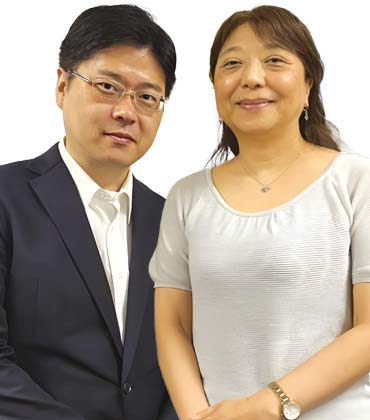
 Shin Yoshida, Co-Founder and CEO and Madoka Takai, Technical Advisor/CTO, Co-Founder
It all began when Professor Madoka Takai, from the Department of Bioengineering, tasked a student with synthesizing a polymer using a biocompatible zwitterionic monomer—molecules carrying both positive and negative charges.
What initially appeared to be a failed experiment—resulting in a sludge-like gel—soon revealed its hidden potential.
Takai noticed that the gel exhibited unique, amoeba-like behavior, spontaneously changing its shape to capture and stabilize target substances. Intrigued by this phenomenon, she dubbed it Amoeba Hydrogel.
The significance of this discovery became even more apparent as further tests showed that the enzymes and microorganisms encapsulated in the gel gained remarkable stability against organic solvents, hydrolytic enzymes, heat and cold.
“What we’ve created here is a versatile substance that can potentially amend how we approach biotechnology across industries. The Amoeba Hydrogel acts as a protective, adaptive cocoon for biomaterials, allowing them to withstand conditions they normally couldn’t,” says Shin Yoshida, co-founder and CEO.
The applications for Amoeba Hydrogel technology are vast. From pharmaceuticals and environmental remediation to food technology and industrial biocatalysts, the ability to stabilize and protect enzymes and microorganisms opens up new possibilities for efficiency, sustainability and innovation.
The Chemistry behind the Shape Shifter
Amoeba Hydrogel retraces what a hydrogel can do. Traditional hydrogels depend on rigid chemical cross-linking, creating a barrier that locks enzymes and materials in place. Amoeba Hydrogel breaks free from that limitation with a smarter design, using physical bonding between polymers. This creates a loose, flexible structure that welcomes the flow of substances, whether enzymes or biomaterials, allowing everything to move and interact freely.
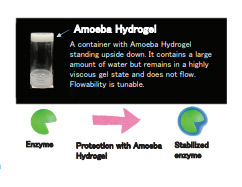 “Think of it as an open system. Enzymes stay active and materials pass through without restrictions. This makes a world of difference in industries where enzyme stability is crucial, like biocatalysis and other industrial processes,” says Yoshida.
It’s built on a foundation of biocompatibility, made possible by zwitterionic and succinimide ester groups.
These features ensure seamless integration with biological systems while giving the flexibility to modify them. Whether it’s enzymes, proteins, cells or other molecules, this hydrogel adapts to specific needs. And because it swells when hydrated, users can adjust its flow and structure by simply altering the water content.
Amoeba Hydrogel’s adaptability makes it even more exciting. The gel size, diffusion speed and overall structure can all be tuned to fit nuanced applications for biomedical or industrial use. Unlike traditional hydrogels that rely on hard chemical bonds, Amoeba Hydrogel leverages loose, hydrophobic polymer interactions to create a porous structure—one that doesn’t trap anything but rather facilitates smooth diffusion.
What does this mean in practice?
Enzymes encapsulated within the hydrogel possess long-term stability, even under harsh conditions. They stay active and are protected against degrading enzymes. In addition, Amoeba Hydrogel is resistant to organic solvents, like phosphate buffer saline, making it tough enough to handle industrial environments.
Enzymes and high-quality raw materials—vital to biological processes—are typically fragile and prone to breakdown when exposed to heat, solvents or prolonged storage. Amoeba Hydrogel flips that script, providing a flexible, protective cocoon that shields enzymes from harsh conditions, allowing them to function at higher temperatures and in more aggressive environments without losing effectiveness.
“The breakthrough couldn’t have come at a better time. For years, biomanufacturing has struggled with the costs and complexities of enzyme degradation, often limiting the industry’s ability to scale. Our hydrogel changes all that, offering enzymes a second, third and even fourth life, allowing them to be reused again and again,” says Yoshida.
We have been proactive from the beginning, filing multiple patents to secure our technology and maintain our position as leaders in enzyme stabilization
This dramatically lowers costs and enhances the efficiency of production processes, making biomanufacturing not only feasible but profitable. Amoeba Hydrogel allows exploring reactions that were once too volatile or inefficient to pursue. This expands the horizons of biotech, enabling the development of products that previously seemed out of reach.
Chemical reactions using biological substances are known to be extremely energy-efficient and can produce chemicals with lower energy consumption and high production yield, so they are attracting attention as a new production method for avoiding carbon dioxide emissions. With the protection of Amoeba Hydrogel, these reactions become even more viable, contributing to more sustainable production methods.
For instance, active pharmaceutical ingredients (API) production, which struggled with enzyme costs, degradation and labor-intensive enzyme modifications, can be significantly improved with Amoeba Hydrogel.
“Enzymatic reactions can proceed at elevated temperatures and in organic solvents when enzymes are protected by Amoeba Hydrogel. This protection enables the use of lipophilic substrates, which were previously impractical due to solubility challenges. The enhanced thermostability and solvent resistance of these enzymes significantly accelerate reaction rates, making API production more economically viable,” says Yoshida.
Anti-Proteinase of Biopharmaceuticals
Hydrogels are also being incorporated into biopharmaceutical applications and drug delivery systems, expanding their potential to update patient care. By improving the anti-proteinase stability of biopharmaceuticals, Amoeba Hydrogel shields these therapies, extending their efficacy within the body and ensuring more effective drug delivery.
Gel Coat Biomaterials is aggressively expanding its project pipeline through joint R&D with partner companies interested in stabilizing biotechnology with hydrogel-stabilized biotechnology. This collaborative approach strengthens the potential for hydrogel-enhanced treatments, pushing the boundaries of what’s possible in modern medicine and revolutionizing patient care across a diverse field.
Transforming Waste Treatment and Plastic Recycling
Talking about environmental advantages, Amoeba Hydrogel allows bioprocesses to run at lower temperatures than traditional chemical methods, reducing energy consumption and slashing CO2 emissions.
For instance, industries ranging from waste treatment to recycling—including plastic decomposition—will significantly reduce their carbon footprint with Amoeba Hydrogel. Operating under milder conditions, like 40°C instead of 100°C or 200°C, not only cuts energy consumption but also accelerates plastic breakdown, making enzymatic recycling an efficient solution for large-scale plastic waste management.
The medical implications are equally significant. The prospect of stable biofuel cells functioning reliably within the human body, powering implantable devices for extended periods, is now within reach. Amoeba Hydrogel’s ability to protect enzymes from bodily degradation brings us closer to realizing this potential.
The characteristics of Amoeba Hydrogel have been found to be helpful in developing biofuel cells and implantable medical devices.
Gel Coat Biomaterials has encapsulated enzymes, electrodes and electron mediators to create biofuel cells capable of generating electricity directly from the sugars and enzymes in living organisms. These biofuel cells operate with remarkable stability—lasting over three months in vitro—and open new doors for long-term, in vivo applications.
“We can envision a future where implantable devices no longer rely on bulky lithium batteries prone to corrosion or wireless power supplies that demand invasive coil implants. With hydrogel-stabilized biofuel cells, the need for such cumbersome technologies’ fades,” says Yoshida.
These cells generate continuous electricity within the body, paving the way for next-generation treatments for neurological disorders, including deep brain stimulation, electrotherapy, epilepsy and Parkinson’s disease. They also hold promise for treating malignant tumors and chronic conditions like rheumatoid arthritis and heart disease.
Even in cancer treatment, technology offers a groundbreaking shift. Hydrogel-enhanced biofuel cells support light emission treatments like photodynamic therapy, providing a safer, more precise alternative to high powered lasers, which can cause painful heat stress and struggle to treat deep-seated tumors.
Gel Coat Biomaterials is advancing light-emitting biofuel cell technology further, developing devices that produce electrical signals and luminescence in vivo. This will pave the way for innovative treatments of malignant tumors and other intractable diseases.
The Minds Shaping Gel Coat Biomaterials’ Future in Biotech
A product’s success reflects the team that created it; in Gel Coat Biomaterials’ case, that’s evident.
Polymer wizard Professor Takai, now co-founder and CTO of Gel Coat Biomaterials, leads this effort. As a distinguished professor at The University of Tokyo, she is a renowned figure in bioindustry innovation. Her forward-thinking approach and research have made her a sought-after speaker at global events. Professor Takai’s leadership has been pivotal in shaping Amoeba Hydrogel. Her expertise extends to cutting-edge research, including a significant study titled “A Modifiable, Spontaneously Formed Polymer Gel with Zwitterionic and N-Hydroxysuccinimide Moieties for an Enzymatic Biofuel Cell” published in ACS Applied Polymer Materials in 2021. This work, co-authored with Yixuan Huang and Tsukuru Masuda, showcases the potential of polymer gels in enzymatic biofuel cells, underscoring her contributions to advancing both academic and practical applications in polymer science.
Supporting her is Dr. Maki Ito, a polymer science expert with a background as a research fellow at Dow Chemical. Now heading Gel Coat Biomaterials’ global R&D, Dr. Ito drives the development of new polymers, ensuring the company remains at the forefront of technological advances. Dr. Satoshi Yamashita, another key team member, is a biotechnology specialist focusing on hydrogel’s physical and material properties, further enhancing its potential in medical applications.
Yet, no innovation reaches its full potential without protection and that’s where Yoshida’s expertise in intellectual property (IP) comes into play. Drawing on seven years of experience leading Dow Chemical’s IP efforts, Yoshida ensures Gel Coat Biomaterials protects its discoveries with a robust patent strategy. The company has filed multiple patents in less than a year, securing its technological edge in a competitive market. Together, this team drives Gel Coat Biomaterials’ success through groundbreaking science, strategic foresight and innovation protection.
“Many startups fail to prioritize IP protection, leaving them vulnerable to competition,” says Yoshida. “We have been proactive from the beginning, filing multiple patents to secure our technology and maintain our position as leaders in enzyme stabilization.”
The story of Gel Coat Biomaterials and the discovery of Amoeba Hydrogel exemplifies how curiosity and innovation can turn unforeseen outcomes into groundbreaking advancements.
As it expands its applications and pushes the boundaries of biotechnology, one thing is certain— Amoeba Hydrogel is only the beginning of a future rich with possibilities. With the right team, vision and strategy in place, Gel Coat Biomaterials stands at the forefront of a biotech revolution, driving change that will impact industries and improve lives globally.
